


Romanian National Recovery and Resilience Plan (NRRP)
#NextGenerationUE : Funds for Modern and Reformed Romania!

Romanian National Recovery
and Resilience Plan (NRRP)
#NextGenerationUE : Funds for Modern
and Reformed Romania!
Project: Visible-to-Ultraviolet Light Conversion Technology
for the Cost-Effective Fight Against Infectious Diseases


Project: Visible-to-Ultraviolet Light Conversion Technology for the Cost-Effective Fight Against Infectious Diseases
Visible-to-Ultraviolet Light Conversion Technology
for the Cost-Effective Fight Against Infectious Diseases
• Project code: C9-I8-C28
• Contract no. 760107/23.05.2023
• Project director: Prof. Dr. Miroslav Dramicanin
• Acronym: lighTechAID
• Host Institution: ¹INCEMC Timisoara
¹National Institute of Research and Development for Electrochemistry and Condensed Matter Timisoara.
I8 – A program to attract highly specialized scientists from abroad in research, development and innovation activities.
Project
In this project, we intend to develop novel up-conversion phosphors for UVC light-emitting diodes (UVC-LEDs), antimicrobial surface coatings, and membranes. This could improve the antimicrobial ultraviolet C (UVC) radiation applications. The obtained results will form the basis for a future EU Horizon proposal to expand the applicability of these technologies to devices for the successful combat of COVID-19 and other infectious diseases. In addition, the outcomes will improve the quality of Romanian science in the field and contribute to the growth of the innovative competencies of students. The project envisions the creation of new Pr³⁺-doped phosphors with an efficient upconversion of visible light to UVC radiation. The host materials will be chosen using a novel method that combines machine learning/artificial intelligence (ML/AI) and high-throughput calculations. In the first step, an ML/AI model will be built from existing literature data using a combination of compositional and structural descriptors. The calculations will then be applied to the large number of compositions stored in Pearson’s Crystal Database, and the resulting descriptors will be fed into the ML/AI model, which will predict the relevant optical properties. Finally, the best crystal hosts will be chosen based on chemical stability, bandgap, 4f² → 4f¹5d¹ Pr³⁺ transition energy, and a few other parameters for synthesizing effective phosphors. The selected crystal hosts and Pr³⁺ combinations will be synthesized as fine crystalline powders using conventional chemical methods and thoroughly characterized structural and optical. For the UVC-LED, surface coating, and membrane fabrications, three of the best Pr³⁺ phosphors will be used. The UVC-LEDs will be covered with Pr³⁺ phosphors in UV transparent resin coating on the chip surface. Biodosimetry will be used to figure out how well UVC-LEDs, surface coatings, and membranes kill microorganisms.
Project objectives
O1. Estimation of properties for inorganic visible to UVC upconversion phosphors containing Pr³⁺ via machine learning and high-throughput DFT calculations.
O2. Synthesis of inorganic visible-to-UVC upconverting phosphors containing Pr³⁺ ions.
O3. Fabrication of phosphor-converted UVC-LEDs, antimicrobial surface coatings and polymeric membranes.
Project team
Highly specialized researcher I
The project director, Prof. Dr. Miroslav D. Dramićanin, is a highly specialized researcher in the field of Materials Science with considerable experience in the development and characterization of various luminescent compounds (h-index 63 acc. Google Scholar). He is the author of over 310 scientific papers in peer-reviewed journals and 20 plenary lectures at international conferences as an invited speaker. His research works are appreciated and recognized, having more than 17486 citations.
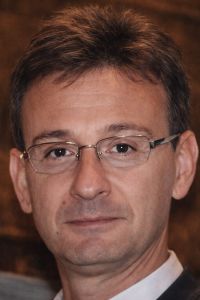


Highly specialized researcher II
The Prof. Dr. Mihail G. Brik scientific interest’s and expertise area is theoretical spectroscopy of rare earth and transition metal ions in optical materials, Crystal field theory, Density functional theory calculations of physical properties of pure and doped luminescent compounds. He is a co-editor and author of various books and book chapters and more than 250 research papers in the international journals. According to Google Scholar, he has more than 19016 citations an h-index 69. Besides many significant awards in 2006 he received also the “Dragomir Hurmuzescu” Award of Romanian Academy.


• Postdoc Physics – biology
Dr. Cristina Moșoarcă
• Ph.D. stud. Chemistry
M.Sc. Mădalina Ivanovici
• Ph.D. stud. Cheminformatics
M.Sc. George Dima
• Support staff
Dr. Doru Buzatu
News, events and results
As we approach the end of our project, we have achieved our target of 10 papers and still have time for even more results :).
We have published 8 papers, and 2 have been accepted for publication and will be available online later this month.
- “Concentration and temperature dependence of Pr³⁺ f-f emissions in La(PO₃)₃”, authors: Željka Antić, Andrei V. Racu, Mina Medić, Abdullah N. Alodhayb, Sanja Kuzman, Mikhail G. Brik, Miroslav D. Dramićanin, journal: Optical Materials, Volume 150, April 2024, 115226, https://doi.org/10.1016/j.optmat.2024.115226
- “Nanosized Eu³⁺-Doped NaY₉Si₆O₂₆ Oxyapatite Phosphor: A Comprehensive Insight into Its Hydrothermal Synthesis and Structural, Morphological, Electronic, and Optical Properties”, authors: Madalina Ivanovici, Aleksandar Ćirić, Jovana Periša, Milena Marinović Cincović, Mikhail G. Brik, Abdullah N. Alodhayb, Željka Antić, Miroslav D. Dramićanin, journal: Nanomaterials, Volume 14, no. 20, 2024, 1639, https://doi.org/10.3390/nano14201639
- “Pr³⁺ visible to UV upconversion for antimicrobial applications”, authors: M.D. Dramićanin, M.G. Brik, Ž. Antić, R. Banica, C. Mosoarca, T. Dramićanin, Z. Ristić, G.D. Dima, T. Förster, M. Suta, journal: Nanomaterials, Volume 15, no. 7, 2025, 562, https://doi.org/10.3390/nano15070562
- “Design principles for (efficient) excited-state absorption-based blue-to-UV upconversion phosphors with Pr³⁺”, authors: T. Förster, J. Reifenberger, T. Moumin, J. Helmbold, Ž. Antić, M.D. Dramićanin, M. Suta, journal: Chemical Science, 2025, Advance Article, DOI: 10.1039/D5SC01862E
- “Machine learning-based predictions of the 4fⁿ-4fⁿ⁻¹5d¹ UV absorption for Pr³⁺ and Ce³⁺ ions in fluoride and oxide compounds”, authors: G. Dima, A.V. Racu, C.G. Ma, A.M. Srivastava, Ž. Antić, M.D. Dramićanin, M.G. Brik, journal: Journal of Luminescence, Volume 286, 2025, 121359, https://doi.org/10.1016/j.jlumin.2025.121359
- “Dy³⁺-Activated NaY₉Si₆O₂₆ luminescent ceramic powder: Optical and thermometric properties”, authors: J. Periša, M. Ivanovici, Z. Ristić, N. Alanazi, A.N. Alodhayb, Ž. Antić, M.D. Dramićanin, journal: Ceramics International, In Press, 2025, https://doi.org/10.1016/j.ceramint.2025.06.023
- “High-Color-Purity Orange Luminescence from Sm³⁺-Doped NaY₉Si₆O₂₆ Oxyapatite Nanophosphors for Optoelectronic Applications”, authors: Jovana Periša, Sanja Kuzman, Madalina Ivanovici, Zoran Ristić, Abdullah N. Alodhayb, Željka Antić, Miroslav D. Dramićanin, journal: Materials Research Bulletin, Volume 196, 2026, 113909, https://doi.org/10.1016/j.materresbull.2025.113909
- “First-principles calculations of the structural and electronic properties of pure and Ce³⁺-doped Y₂O₃”, authors: A.V. Racu, D. Vizman, Ž. Antić, M.D. Dramićanin, M. Piasecki, M.G. Brik, journal: Optical Materials, Volume 177, 2026, 118182, https://doi.org/10.1016/j.optmat.2026.118182.
#NextGenerationUE
#EUFounding
#lighTechAID
#Romania
#PNRR
#NRRP
Share
Continuing our activities abstract entitled “Y2SiO5:Pr3+/PDMS COMPOSITES FOR GERMICIDAL APPLICATIONS” by Radu Banică, Željka Antić, Miroslav D. Dramićanin, Cristina Moșoarcă and Mirela Iorga
was presented as a poster at the TIM 24 Physics Conference organized by the West University of Timisoara, Faculty of Physics, May 30th – June 1st, 2024, Timisoara, Romania. https://timconference.uvt.ro/
#NextGenerationUE
#EUFounding
#lighTechAID
#Romania
#PNRR
#NRRP
Share
Continuing our activities to identify host materials for Pr³⁺ doping, we have published our results „Concentration and temperature dependence of Pr³⁺ f-f emissions in La(PO₃)₃”, authors: Željka Antić, Andrei V. Racu, Mina Medić, Abdullah N. Alodhayb, Sanja Kuzman, Mikhail G. Brik, Miroslav D. Dramićanin, journal: Optical Materials Journal, Volume 150, April 2024, 115226, https://doi.org/10.1016/j.optmat.2024.115226
#NextGenerationUE
#EUFounding
#lighTechAID
#Romania
#PNRR
#NRRP
Share
Our final version of the site – https://lightechaid.ro/ was launched
Thanks to:
#WEBSE – Web Design
#NextGenerationUE
#EUFounding
#lighTechAID
#Romania
#PNRR
#NRRP
Share
We participated and presented our scientific results at The 2nd Serbian Conference on Materials Application and Technology – SCOM and at The 29th International Symposium on Analytical and Environmental Problems in Hungary.
https://www.razvojnauke.org/gallery/SCOM23%20Book%20of%20Abstract.pdf
http://www2.sci.u-szeged.hu/isaep/index_htm_files/Proceedings_ISAEP_2023.pdf
#NextGenerationUE
#EUFounding
#lighTechAID
#Romania
#PNRR
#NRRP
#UniversityofSzeged
Share
The start of the NRRP project C9-I8-C28 was announced in a local newspaper Ziua de Vest.
#NextGenerationUE
#EUFounding
#lighTechAID
#Romania
#PNRR
#NRRP
Share
We are happy to inform you that our project proposal “Visible-to-Ultraviolet Light Conversion Technology for the Cost-Effective Fight Against Infectious Diseases” for the NRRP i8 project competition (domain of Physical sciences and engineering) – is in 6th place of 99 projects.
So let’s do it!⠀🙂
https://www.mcid.gov.ro/wp-content/uploads/2023/05/PSE-REZULTATE-FINALE-_-16.05.2023.pdf
#NextGenerationUE
#EUFounding
#lighTechAID
#Romania
#PNRR
#NRRP
Share